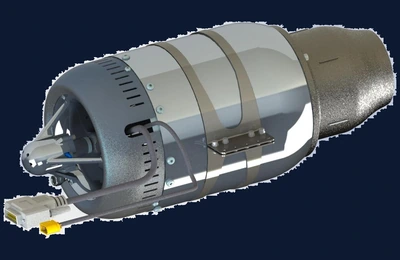
How much thrust does the SF40 produce?
40 kgf minimum, which is 392 N or 88 lbf at sea-level static conditions. Maximum core speed is 91,500 rpm, exhaust gas temperature stays at or below 850 °C, and specific fuel consumption is 1.55 kg per kgf per hour or better.
What does the SF40 weigh?
4.6 kg dry or less for the bare engine, with a maximum diameter of 149.5 mm and an overall length of 372.4 mm. That gives a bare-engine thrust-to-weight ratio of 8.7 : 1. Add the ECU, GSU, pump, valves, tubing and harness for your installed weight — we quote that per configuration rather than publishing one number.
How much fuel does the SF40 burn?
At 1.55 kg/(kgf·h) and 40 kgf, roughly 62 kg of blended kerosene per hour, or about 78 litres at a density of 0.8 g/ml. The blend is RP-3 with 5% Mobil Pegasus II or AeroShell 500 by volume.
What size of aircraft is the SF40 suited to?
Roughly 60 to 90 kg maximum take-off weight at an installed thrust-to-weight ratio of 0.5 to 0.65. Treat that as a starting point rather than a limit — wing loading, climb requirement and how much of the sortie sits at maximum thrust all move the number.
Does the SF40 require an export licence?
It sits under the 400 N control threshold at 392 N, but only by 8 N, so every order is reviewed individually rather than treated as uncontrolled. An end-user certificate is required in all cases, plus a licence where the destination or application calls for one. Full detail is on the compliance page.
What is the service interval?
25 hours of running time for bearing inspection and turbine clearance, about 150 ten-minute sorties. Turnaround time and service kit price are quoted per project because both depend on where the engine is based.
What telemetry does the SF40 provide?
A 36-byte frame every 40 ms over RS-232 at 115,200 bps, 8N1, on a DB15 male connector. The frame carries speed, exhaust temperature, ECU mode, current, alarm word, fault word and switch word, all documented bit by bit. Warning and fault bits latch, so a post-flight read still shows what happened.
How fast does it start, and can it restart in the air?
Under 45 seconds from cold to idle on the ground, with acceleration inside 18 seconds and deceleration inside 25 seconds. In flight, after a flame-out, the ECU relights automatically once speed falls below 6,000 rpm with altitude below 5,500 m and airspeed below 450 km/h, provided every sensor and accessory reports healthy.
How does it compare with other 40 kgf engines?
At 40 kgf the trade-off is cost per flight hour against installed weight. The SF40 is the short-life, low-cost platform: 4.6 kg, 91,500 rpm, 25-hour TBO, built for high-cycle work where the engine is a consumable. Lighter general-purpose units in this class exist at around 3.2 kg dry and suit airframes where every gram of installed weight counts — if that is your case, send us the airframe and the model you are comparing and we will return a line-by-line table. If the engine is going to be run hard and replaced on a schedule, this is the one.
How do I get a price and lead time?
Send the model, quantity, destination country and intended use. A written quotation with the full datasheet comes back. Prices are quoted per order rather than published as a list, because ECU version, harness length, spare kit and the export documentation set all change the number.