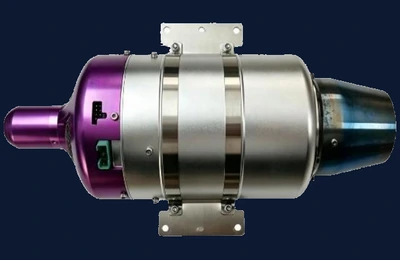
SF12 12 kgf turbojet engine
SF Series · New

SF12

12 kgf / 117.7 N Class · 35,000–126,000 rpm

117.7 N from a 100 mm airframe that weighs 1.55 kg. A 35,000 rpm idle, a ground unit that logs every run to an SD card, and a standard PWM throttle input — bind it to any receiver and fly.

12 kgf
Max Thrust
117.7 N
Rated Force
1,550 g
Dry Weight
7.7:1
T/W (bare)
126,000
Max RPM
Ø100 mm
Max Diameter
Specifications

Twelve kilos of thrust, 279 mm long

Measured at 15 °C ambient. This is the smallest engine in the SF range, and the one that fits where nothing else will: a 100 mm case in a 1/7 or 1/8 scale airframe.

Thrust & Speed

  • Maximum Thrust12 kgf / 117.7 N @ 15 °C
  • Maximum Speed126,000 rpm
  • Idle Speed35,000 rpm
  • Speed Range35,000 – 126,000 rpm
  • Thrust-to-Weight (bare)7.7 : 1
  • Exhaust Gas Temperature750 °C max
  • Fuel Consumption380 ml/min at max thrust
  • Equivalent Mass Flowapprox. 304 g/min / 18.2 kg/h

Physical & Installation

  • Max Case DiameterØ100 mm
  • Exhaust Nozzle DiameterØ68 mm
  • Overall Length279 mm
  • Length, Front to Mount Plane53.5 mm
  • Length, Mount Plane to Nozzle102 mm
  • Mounting Span136 mm between rails
  • Overall Height with Mounts146 mm
  • Mounting Hole DiameterØ4 mm
  • Unit Weight1,550 g
  • MountingTwin rail frame, supplied

Fuel System

  • FuelKerosene
  • Lubricant5 % premix in fuel
  • Consumption380 ml/min
  • Fuel Line4 × 2.5 mm, 2 m supplied
  • PumpSupplied with the set
  • FilterInline, supplied
  • Bubble TrapBubbless tank (BUT), optional
  • FillingFuel tube plug / refuel point

Electrical

  • Supply Voltage3S LiPo, 11.1 V
  • Main ConnectorXT60
  • Main Power CableSupplied
  • Fuel Pump SupplySeparate XT60 branch, same battery
  • StarterOn-board electric starter
  • Throttle CableSupplied

Control & Ground Support

  • Throttle InputPWM from receiver, or ground unit
  • ReceiverStandard channel, optional
  • Ground UnitData T/PC terminal, LCD + 5 keys
  • Data LoggingSD card slot on the terminal
  • StartFrom the ground terminal, on-board starter
  • SetupParameters set on the terminal — no code, no serial driver

Accessories & Logistics

  • Engine Body1 unit
  • Ground Support Terminal1 pc (Data T/PC)
  • Ground Support Cable1 pc
  • Fuel Pump1 pc
  • Fuel Filter1 pc
  • Fuel Tube2 m, 4 × 2.5 mm
  • Main Power Cable1 pc
  • Throttle Cable1 pc
  • Service Interval25 h
Why This Engine

Small, but not a black box

At this size most engines ship as a sealed unit with a throttle lead. This one gives you the ground terminal, the wiring diagram, and the piping layout — enough to build the installation without guesswork.

Ground unit logs to SD card

The Data T/PC terminal carries an LCD, five keys and an SD slot. Every run is written to card, so you can compare a good start against a bad one instead of guessing from the sound of it.

Standard PWM throttle

Plug it into any receiver channel. No serial protocol to implement, no driver to write, no firmware to match. The same lead works whether you fly it or run it on a bench.

3S, not 6S

11.1 V from a 3S pack. The same battery you already carry for the receiver and servos runs the engine and the pump, through two XT60 branches.

35,000 rpm idle

A low idle means a fine thrust step at the bottom of the range. On approach and in formation you get resolution where you actually need it, not just at the top end.

Wiring and piping drawn out

Two full connection diagrams ship with the engine: electrical (battery, pump, receiver, terminal) and fuel (tank, bubble trap, pump, filter, engine). Build the install from the drawing.

25-hour service interval

Stated as a plain number, not a range. At 380 ml/min that is roughly 570 litres of fuel between services — budget it as a consumable and the cost per flight stops being a surprise.

Applications

Where 100 mm and 12 kgf fit

Roughly 12 to 15 kg all-up at an installed thrust-to-weight ratio of 0.8 to 1.0, which covers most 1/7 and 1/8 scale jet airframes. Wing loading and field length move the number.

Scale jet models

Ø100 mm case, 279 mm long, twin rail mounts. Fits the 1/7 and 1/8 scale airframes that cannot take a wider engine without cutting into the ducting.

Target and training drones

12 kgf is enough for a 10 kg class airframe at close to unity thrust-to-weight. The SD log gives you a record of every flight for post-run review.

Competition and display flying

Fast throttle response from a low idle, and a 25-hour service interval that matches a season of weekend flying without a mid-season rebuild.

Bench and teaching rigs

PWM input and a terminal with a display make it usable as a teaching engine: students see the start sequence, the EGT trace and the fuel flow on the same screen.

Export control: below the 400 N threshold

At 117.7 N the SF12 sits well below the 400 N dual-use threshold (9A012.b.3), at roughly 29 % of it — not at the boundary. Orders for most destinations ship under normal commercial rules without an export licence.

Two conditions still apply. We ask for a written statement of the civil application — model aviation, target drone, research or display — and we do not supply this engine for military, law-enforcement or weapon-integrated use, or for re-export to a restricted destination. If a destination requires a licence under its own import rules, that is the buyer's responsibility to obtain before shipment.

FAQ

Questions buyers actually ask

If your question is not here, send it. We answer specification questions with the datasheet page number attached.

How much thrust does the SF12 produce, in newtons?

12 kgf, which is 117.7 N or 26.5 lbf. The figure is measured at 15 °C ambient. Expect a small drop on a hot day — thrust scales roughly with air density, so at 35 °C you lose a few percent.

What is the thrust-to-weight ratio?

7.7 : 1 on the bare engine at 1,550 g. That is the bare figure only — add pump, filter, tubing, ECU wiring and the battery branch and the installed ratio falls. We quote bare because that is the number you can verify on a scale.

What battery does it need?

A 3S LiPo at 11.1 V, connected through XT60. The pump runs from a separate XT60 branch off the same pack. There is no 6S or 8S requirement at this thrust class, so the engine shares the receiver battery.

How long can it run on a given tank?

Consumption is 380 ml/min at maximum thrust. A 2 litre tank therefore gives about 5.3 minutes at full power, or considerably longer at part throttle since flow drops with speed. Plan on the full-thrust number for endurance limits and you will not run dry on approach.

What fuel and oil does it take?

Kerosene with 5 % turbine oil premixed. The 5 % figure is not a suggestion — it is the lubrication budget for the bearings at 126,000 rpm. Do not substitute a lower ratio to save on oil.

How often does it need servicing?

Every 25 hours of running. At 380 ml/min that is roughly 570 litres of fuel. Treat the engine as a consumable with a known life rather than a capital item, and the cost per flight becomes predictable.

How is it controlled?

Two ways. In flight, a standard PWM throttle lead from any receiver channel. On the bench, the Data T/PC ground terminal, which has an LCD and five keys for start, stop and parameter changes. No serial protocol implementation is required either way.

Does the ground unit record data?

Yes. The terminal has an SD card slot, so each run is logged to card. In practice this is the most useful diagnostic you get: compare a clean start against a slow one and you can see whether the difference is in the start sequence, the pump ramp or the EGT rise.

How does the SF12 compare with other 12 kgf engines?

At 12 kgf the trade-off is weight against what you can read back after a run. The SF12 is 1,550 g in a Ø100 mm case, 279 mm long, idling at 35,000 rpm with an SD-logging ground terminal and a plain PWM throttle lead — bind it to any receiver and fly. Lighter and shorter 12 kgf units exist, and they are the right answer when every gram counts. What they generally do not give you is a logged record of every run. If weight is your binding constraint, send us the airframe and the model you are comparing and we will return a line-by-line table. If you want the run log without adding instrumentation, this is the one.

Does it need an export licence?

No, for most destinations. At 117.7 N it is at about 29 % of the 400 N dual-use threshold, so it ships under normal commercial rules. We still ask for a written civil-application statement, and we do not supply it for military or law-enforcement use or for onward export to restricted destinations.
Request the SF12 datasheet

Full specification sheet, dimensional drawing, wiring diagram and fuel piping layout. Tell us the airframe and the destination country and we will confirm lead time and shipping terms.

Email WhatsApp