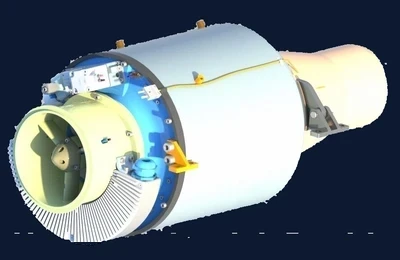
How much thrust does the SF160 produce?
160 kgf, which is 1,568 N or 352 lbf at the maximum rating. The rotor runs between 25,000 and 46,000 rpm, and the maximum rating is limited to 10 minutes continuous. Idle thrust is about 12 kgf with no time limit.
What does the SF160 weigh?
20.88 kg dry, with a maximum diameter of 264 mm and an overall length of 614 mm. That gives a bare-engine thrust-to-weight ratio of 7.7 : 1. The figure is dry weight only - add fuel system, ECU harness and mounting hardware for your installed weight.
How much fuel does the SF160 burn?
Specific fuel consumption is 1.33 kg/(kgf·h) at maximum state, so full-thrust flow works out to roughly 213 kg/h of RP-3. At idle the SFC rises to 3.20 kg/(kgf·h) but thrust drops to about 12 kgf, so idle flow is roughly 38 kg/h. For a 10-minute max-state sortie, budget about 36 kg plus start, taxi and idle time.
What size of aircraft is the SF160 suited to?
It is a 160 kgf class engine. At a typical installed thrust-to-weight ratio of 0.4 to 0.6, that points at platforms in roughly the 270 to 400 kg maximum take-off weight range. Treat it as a starting point rather than a limit: the real number depends on wing loading, climb requirement, and how much of the flight is spent at maximum state.
Does the SF160 require an export licence?
Yes. At 1,568 N it is well above the 400 N threshold in China's dual-use export control list effective 18 November 2026 (Ministry of Commerce Announcement No. 49), so it is classified under 9A012.b.3. Every shipment needs a licence, an end-user certificate and a statement of end use. We quote lead time only after the licence position is clear.
What is the service interval?
20 hours TBO. At 10-minute sorties that is roughly 120 flights between services. The engine is built on a swap-rather-than-overhaul philosophy: short service life, low unit cost, and a replacement rather than a workshop return. Service kit pricing is quoted per project.
What telemetry does the SF160 provide?
RS-422 over a DB9 connector at 115,200 bps, 8N1. The ECU sends a 36-byte telemetry frame every 40 ms with a 0xA5 header and a CRC8 checksum (polynomial 0x07), and accepts 12-byte command frames. Eight operating states are defined, plus a 9-bit warning word and a 13-bit fault word - all documented bit by bit, so the interface can be written before delivery.
What happens if the engine flames out in flight?
The ECU attempts an automatic relight when speed has dropped below 8,000 rpm, altitude is below 5,000 m, airspeed is below 300 km/h, and every sensor and accessory reports healthy. If your flight controller's flameout logic deploys a recovery device, the two will conflict. The ECU only stops trying when it receives an explicit stop or emergency-stop command.
Why is there a gap between 80 kgf and 400 kgf, and where does the SF160 fit?
Above 80 kgf the off-the-shelf options thin out sharply — most catalogues jump from the 60 to 80 kgf class straight to 300 to 400 kgf units. The SF160 fills that step: 160 kgf from 20.88 kg, twice the thrust of the 80 kgf class for about 2.5 times the dry weight, with Ma 0.95 and a 12,000 m ceiling. Choose on mission altitude and dash requirement, not on thrust alone.
How do I get a price and lead time for the SF160?
Send the airframe type, quantity, destination country and intended use. Because this thrust class is export-licensed, the reply will cover both the commercial quote and the documentation set required. Expect a written response on the commercial side; licence timing depends on the destination.