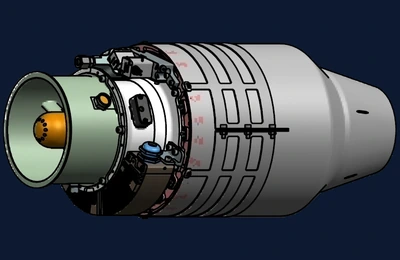
SF80 80 kgf turbojet engine
SF Series · New

SF80

80 kgf / 784 N Class · 30,000–60,200 rpm

784 N from a 202 mm airframe weighing 10.5 kg. Four measured operating points, a 50-second ground start, and an RS-422 ECU protocol published down to the bit — including the RS-232 fallback on the same connector.

80 kgf
Max Thrust
784 N
Rated Force
10.5 kg
Dry Weight
7.6:1
T/W (bare)
60,200
Max RPM
12,000 m
Ceiling
Specifications

Every number, at every operating point

Sea-level standard atmosphere, static condition. Four points are published rather than one, because a single maximum figure tells you nothing about how the engine behaves at cruise.

Thrust & Speed

  • Maximum Thrust≥ 80 kgf @ 60,200 rpm
  • Rated Thrust≥ 78 kgf @ 60,000 rpm
  • Intermediate Thrust≥ 59 kgf @ 55,000 rpm
  • Idle Thrust≤ 12 kgf @ 30,000 rpm
  • Continuous Rating10 min max · 60 min rated · unlimited intermediate
  • Acceleration10 s
  • Deceleration10 s

Weight & Dimensions

  • Dry Weight10.5 kg
  • Maximum Overall Diameter202 mm
  • Inlet Inner Diameter121.4 mm
  • Overall Length479 mm
  • Thrust-to-Weight (bare)7.6 : 1
  • Frontal Thrust Densityapprox. 24,500 N/m²

Envelope

  • Max Operating Altitude12,000 m
  • Max Operating MachMa 0.9
  • Operating Temperature−40 °C to +60 °C
  • Min Starting Temperature−40 °C
  • Max Starting Altitude5,000 m
  • Air Restart Envelopebelow 5,000 m and 300 km/h
  • Ground Start Time≤ 50 s

Thermal & Fuel Burn

  • EGT at Max770 °C
  • EGT at Rated750 °C
  • EGT at Intermediate670 °C
  • EGT at Idle595 °C
  • SFC at Max / Rated1.38 kg/(kgf·h)
  • SFC at Intermediate1.48 kg/(kgf·h)
  • SFC at Idle3.8 kg/(kgf·h)
  • Fuel Flow at Maxapprox. 110 kg/h

Air & Fuel System

  • Air Flow at Max1.55 kg/s
  • Air Flow at Idle0.64 kg/s
  • FuelRP-3 aviation kerosene
  • Lubricant5% Mobil Pegasus II or AeroShell 500 by volume
  • Supply Pressureambient + 30–50 kPa gauge
  • Filtration20–50 micron
  • Fuel Line10 × 6.5 mm transparent PU
  • Service Interval (TBO)25 h

Electrical & Data

  • Supply Voltage28 V DC nominal, 24–32 V
  • Starting Peak Power< 1,000 W (< 5 s)
  • Steady-State Power< 150 W
  • Power ConnectorAmass XT60H-M
  • BusRS-422, DB9 male, 115,200 bps 8N1
  • FallbackRS-232 RX/TX/GND on pins 7, 8, 9
  • Telemetry Frame36 bytes every 40 ms, header 0xA5
  • Command Frame12 bytes, 13 command codes
  • Cold Run Cycle2,500 rpm for 50 s
Why This Engine

The interface is the product

Most suppliers publish six numbers and call it a datasheet. This one publishes the frame layout, every status bit, and what the ECU does when a sensor fails.

Protocol published bit by bit

36-byte telemetry frame every 40 ms, 13 command codes, 8 operating states, 9 warning bits, 13 fault bits and 6 switch bits — all defined. You can write the parser before the engine arrives.

RS-422 with RS-232 fallback

Differential RS-422 on pins 1–5 carries telemetry over long harness runs without ground-loop noise. Pins 7–9 carry RS-232 on the same DB9, so you can bench-test with a laptop before the flight harness exists.

Automatic relight after flameout

On an abnormal flameout the ECU closes the actuators and drops to shutdown. Once speed falls below 8,000 rpm, with altitude below 5,000 m and airspeed below 300 km/h reported by the flight controller, it restarts itself. A shutdown command aborts the sequence.

Four measured operating points

Maximum, rated, intermediate and idle each carry their own thrust, EGT, SFC and air flow. Cruise fuel burn is a lookup, not an estimate — 59 kgf at 55,000 rpm burns 1.48 kg/(kgf·h), not 1.38.

Degrades instead of quitting

A failed speed signal switches closed-loop regulation to open-loop backup at the current pump speed. A failed P2 or T2 sensor reconstructs inlet pressure and temperature from flight-controller data. Only accessory faults block a start.

25-hour TBO, stated plainly

This is a short-life engine and the datasheet says so. 25 hours buys a 10.5 kg powerplant at a fraction of the cost of a long-life unit, and the overhaul interval is the trade you are making.

Applications

Where 80 kgf and Ma 0.9 fit

Roughly 120 to 180 kg maximum take-off weight at an installed thrust-to-weight ratio of 0.45 to 0.6. Treat it as a starting point; wing loading and climb requirement move the number.

Target drone propulsion

High subsonic dash, repeated sorties, engine treated as a consumable. The 25-hour TBO and the low purchase price are designed for exactly this duty cycle.

High-subsonic UAV cruise

Ma 0.9 ceiling with a 12,000 m operating altitude. The intermediate rating gives an unlimited-duration cruise point at 59 kgf.

University and research test beds

Four published operating points, full telemetry, and a documented fault table make it usable as a teaching and measurement platform, not just a powerplant.

Ground test and integration rigs

RS-232 on the same connector means a laptop can drive the engine on the bench. Cool-down running at 2,500 rpm protects the turbine between test cycles.

Export control: above the 400 N threshold

At 784 N the SF80 is a controlled item under dual-use classification (9A012.b.3, China's dual-use export control list effective 18 November 2026). Every export requires a licence. We do not accept bare purchase orders on this thrust class — an end-user certificate and a stated civil application are required before a contract is issued. If you are unsure whether your destination or application is eligible, ask before you order.

FAQ

Questions we get before an order

How much thrust does the SF80 produce?

80 kgf maximum at 60,200 rpm, which is 784 N or 176 lbf at sea-level static conditions. Rated thrust is 78 kgf at 60,000 rpm for up to 60 minutes, intermediate is 59 kgf at 55,000 rpm with no time limit, and idle is 12 kgf or less at 30,000 rpm. Maximum thrust is limited to 10 minutes.

What does the SF80 weigh, and what is the installed weight?

10.5 kg dry for the bare engine, with a 202 mm maximum diameter and 479 mm overall length, giving a bare-engine thrust-to-weight ratio of 7.6 : 1. The ECU, GSU, pump, valves, tubing and harness add to that; installed weight is quoted per configuration because harness length and accessory mounting change the number.

How much fuel does it burn at cruise?

At the intermediate point — 59 kgf at 55,000 rpm — specific fuel consumption is 1.48 kg/(kgf·h), so roughly 87 kg per hour. At maximum it is 1.38 kg/(kgf·h) and about 110 kg/h. Idle burns 3.8 kg/(kgf·h) but only produces 12 kgf, so idle time is cheap in absolute terms but expensive per unit of thrust.

What size of aircraft is the SF80 suited to?

Roughly 120 to 180 kg maximum take-off weight at an installed thrust-to-weight ratio of 0.45 to 0.6. Wing loading, climb requirement and how much of the sortie sits at maximum thrust all move that range — a draggy airframe that needs continuous dash will sit at the top of the band or above it.

Does the SF80 require an export licence?

Yes. At 784 N it is well above the 400 N threshold used in dual-use classification (9A012.b.3), so every export requires a licence plus an end-user certificate. We do not accept bare purchase orders on this thrust class, and we need the civil application stated in writing before a contract is issued.

What telemetry does the SF80 provide?

A 36-byte frame every 40 ms over RS-422 at 115,200 bps, 8N1, on a DB9 male connector. It carries speed, EGT, ECU mode, engine status, warning word, fault word, switch word, target speed, supply voltage and current, inlet total pressure and temperature, ECU temperature, fuel pump speed, two accessory fault codes, fuel pressure and a frame counter — each with a defined scale and unit.

Can I test it without the flight controller?

Yes. The same DB9 carries RS-232 on pins 7, 8 and 9 alongside the RS-422 differential pair, so a laptop or a bench terminal can read telemetry and send commands before the aircraft harness exists. Bench testing over RS-232 first is the fastest way to confirm wiring before you commit to a flight build.

What happens after a flameout in flight?

The ECU closes the actuators and enters shutdown. Once speed drops below 8,000 rpm, and the flight controller reports altitude below 5,000 m and airspeed below 300 km/h, the ECU restarts the engine on its own. Sending a shutdown or emergency shutdown command aborts the restart sequence, which is how you keep manual control of the decision.

How does it compare with other 80 kgf engines?

At 80 kgf the trade-off is installed weight against control architecture. The SF80 is 10.5 kg, runs to 60,200 rpm, carries a 28 V DC system and an RS-422 bus with a documented 36-byte protocol, and is built as a short-life powerplant. Lighter units in this class exist at around 8.4 kg dry with PWM throttle and RS-232 telemetry — the right answer where every gram counts and the control system is already analogue. If weight is your binding constraint, send us the airframe and the model you are comparing and we will return a line-by-line table.

How do I get a price and lead time?

Send the quantity, destination country and intended civil application. A written quotation with the full datasheet comes back. Prices are quoted per order rather than published as a list, because accessory set, harness length, spare kit and the export documentation package all change the number.
Need the full datasheet for the SF80?

Send your platform weight, mission profile and destination country. We will confirm whether the SF80 covers the requirement, send the complete specification including the frame layout and fault table, and quote with the export documentation set your destination needs.

Email WhatsApp