SF100 100 kgf turbojet engine
SF Series · New

SF100

100 kgf / 980.7 N Class · 25,000–60,000 rpm

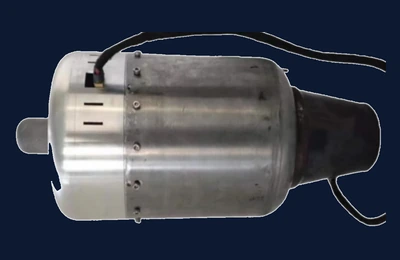
100 kgf from a Ø233 mm case at 12 kg — 499.3 mm overall, 85 mm shorter and 2.5 kg lighter than the SF120. A 25,000 rpm idle that holds 8.5 kgf, and 1.8 kg/s of mass flow at full power.

100 kgf
Max Thrust
980.7 N
Rated Force
12 kg
Dry Weight
8.3:1
T/W (bare)
60,000
Max RPM
Ø233 mm
Max Diameter
Specifications

100 kgf in 499 mm of length

Measured at 15 °C ambient, 1013 mbar. A large-diameter, low-speed rotor — 60,000 rpm instead of 62,500 — which is where the extra service life comes from.

Thrust & Speed

  • Maximum Thrust100 kgf / 980.7 N @ 15 °C
  • Idle Thrust8.5 kgf
  • Maximum Speed60,000 rpm
  • Idle Speed25,000 rpm
  • Speed Range25,000 – 60,000 rpm
  • Thrust-to-Weight (bare)8.3 : 1
  • Idle Thrust Ratio8.5 % of rated (derived)
  • Exhaust Gas Temperature480 – 750 °C

Dimensions & Mounting

  • Max Case DiameterØ233 mm
  • Overall Length499.3 ± 0.5 mm
  • Height, Case Body270.6 mm
  • Height over Mount Lugs279.7 mm
  • Inlet DiameterØ49 mm
  • Nozzle OutletØ101 mm
  • Mount Flange Holes8 × Ø5.2 mm, 28 mm pitch
  • Unit Weight12 kg

Airflow & Exhaust

  • Mass Flow1.8 kg/s at max speed
  • Specific Airflow18.0 g/s per kgf (derived)
  • Nozzle OutletØ101 mm
  • Exhaust Gas Temperature480 – 750 °C
  • Case Sections57.5 / 92.5 / 157 mm
  • Pressure RatioNot published
  • Nozzle TypeFixed convergent
  • Thrust VectoringNone

Fuel System

  • FuelNo. 3 aviation kerosene (Jet A-1 equivalent)
  • Lubricant5 % Mobil Pegasus II or Mobil Jet Oil II, premixed
  • Fuel Flow at Max Speed3,300 ml/min
  • Specific Fuel Consumption1.4 kg/(kgf·h) at max condition
  • Fuel LineNot in this datasheet
  • PumpNot in this datasheet
  • FilterNot in this datasheet
  • Tank VentingNot in this datasheet

Electrical

  • Recommended BatteryLiPo 6S–7S
  • StarterOn-board electric starter
  • Throttle InputNot in this datasheet
  • TelemetryNot in this datasheet
  • ECUNot in this datasheet
  • Igniter SupplyNot in this datasheet
  • Wiring DiagramNot in this datasheet
  • Source DocumentCN and EN pages agree on every parameter

Datasheet Scope

  • Published HereThrust, speeds, weight, envelope dimensions, fuel spec, mass flow, EGT, battery class
  • Flight EnvelopeNot published — ask us
  • Operating TemperatureNot published — ask us
  • Start TimeNot published — ask us
  • Acceleration TimeNot published — ask us
  • Time Between OverhaulNot published — ask us
  • Accessories SuppliedNot published — ask us
  • Standard Conditions15 °C, 1013 mbar
Why This One

The compact end of the heavy class

Three quarters of the SF120's thrust in 85 mm less length and 2.5 kg less mass.

100 kgf in Ø233 mm

Narrower than the SF120 by 9 mm and 85 mm shorter overall. If your nacelle is the constraint rather than the thrust, this is the one to look at.

499.3 mm — 85 mm shorter than the SF120

With the mount flange at 28 mm pitch and eight Ø5.2 mm holes, it drops onto a standard large-frame rail without an adapter plate.

8.5 kgf idle — 8.5 % of rated

A high absolute idle, which matters on a 100 kg class airframe: you can hold an approach without dipping into a region where relight is marginal.

60,000 rpm — lower blade speed

The largest rotor in the 100 kgf class runs slower, not faster. Tip speed and centrifugal load both drop, which is where service life comes from on a big single-stage turbine.

1.8 kg/s of mass flow

18 g/s for every kilogram of thrust. Plenty of breathing margin for a fixed convergent nozzle across a wide altitude band.

750 °C top of band

A tighter exhaust band than the SF60, and a lower absolute ceiling. Downstream structure can be lighter, and the turbine runs further from its metallurgical limit.

Applications

What a 100 kgf engine flies

All-up weights assume a thrust-to-weight ratio between 0.8 and 1.0 at sea level, static.

Large Target Drone

100 to 125 kg all-up. A high subsonic platform where the engine has to fit inside the fuselage, not hang under it.

Long-Range Survey Aircraft

100 to 125 kg all-up. At 1.4 kg/(kgf·h), fuel mass sets your endurance — 12 kg of engine leaves room for it.

Heavy Cargo UAV

100 to 125 kg all-up. The high absolute idle lets a loaded airframe hold a descent without hunting.

Engine Test Platform

Short, light, and well documented on dimensions — a practical host for accessory and control-system development.

Export Status

At 980.7 N the SF100 is roughly 2.45 times the 400 N dual-use threshold in 9A012.b.3. This is not a borderline case and we do not treat it as one. An export licence is required for every destination outside China, with civil end-use documentation, a named end user, and destination paperwork before a delivery date is quoted.

We do not accept a bare purchase order on this class. Lead time here is driven by licensing, not by production capacity — plan accordingly rather than assuming a stock item.

Questions

What buyers ask about the SF100

Is it 100 kgf or 980.7 N?

The same figure in two conventions. The source datasheet is written in kgf; 100 kgf converts to 980.7 N at standard gravity. We publish both so it can be checked either way.

Why does the length carry a ± 0.5 mm tolerance?

Because the source drawing specifies it that way — the figure is a controlled dimension, not a nominal. If you are building a mount that depends on the 499.3 mm face-to-face distance, hold your own tolerance to the same band.

What can 8.5 kgf of idle thrust do?

On a 100 kg airframe it is roughly 8 % of weight, which is enough to hold a shallow descent or a taxi without dropping toward the relight margin. A low idle would force you to keep the throttle up on approach.

How does it compare with the SF120?

The SF120 makes 20 kgf more from 2.5 kg more engine and 85 mm more length. Both sit at 8.3 : 1 thrust-to-weight. Choose the SF100 when the nacelle is tight or the airframe is length-limited; choose the SF120 when you need the extra 196 N and have the space.

How does it compare with the SF80?

The SF80 is 10.5 kg and 479 mm with 784 N. The SF100 adds 196 N for 1.5 kg and 20 mm. If you are already sizing around an 80 kgf engine and can find 1.5 kg, the extra thrust is nearly free.

Is there a serial protocol or an SDK?

Not in the material we hold. This datasheet is mechanical and thermodynamic only — no frame format, no command set, no telemetry map. If a digital interface is a hard requirement, say so at enquiry and we will tell you what actually exists rather than let you design around an assumption.

What is the flight envelope?

Not published. What we have is sea-level static performance at 15 °C and 1013 mbar. We do not extrapolate an altitude or Mach ceiling from a static thrust number. Tell us the band you need and we will get you a real answer.

Only 60,000 rpm — is that a compromise?

It is a design choice, not a limit. A larger rotor turning slower produces the same thrust with lower tip speed and lower centrifugal stress. The trade is 9 mm of diameter against the SF120 and a slightly higher specific fuel consumption.

Can I buy one unit for a private project?

Above 400 N an export licence applies regardless of quantity, so one unit is not a simpler transaction than ten. What we need is identical either way: civil end use, named end user, destination, written statement. With that in order, a single unit is fine.

What is the mounting interface?

The outline drawing shows a mount flange with eight Ø5.2 mm holes on 28 mm pitch, 279.7 mm across the lugs and 270.6 mm across the case body. Send us your frame drawing and we will confirm the bolt pattern before you machine anything.
Need the full SF100 data pack?

Tell us your airframe, your altitude band, and your destination. We will come back with the parameter sheet, the outline drawing, and a realistic lead time — licence first, hardware second.

Email WhatsApp