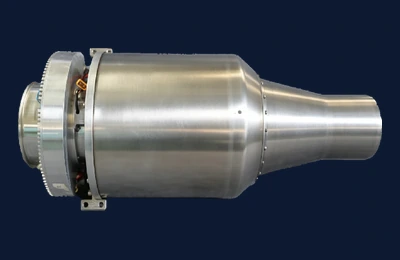
How much thrust is 120 kgf in newtons?
1,176.8 N at maximum power, or 264.6 lbf. The datasheet states it as ≥ 120 kgf at sea level standard conditions, static, with inlet total pressure recovery of 0.99 or better — so the figure is a floor, not an average.
What is the flight envelope?
12,000 m maximum altitude, Ma 0.9 maximum Mach, and an ambient range of −40 to +60 °C. Starting is limited separately: no higher than 5,000 m and no colder than −40 °C. Operating outside these limits risks flameout, overtemperature or overpressure.
How long does a start take, and how fast does it spool?
Fifty seconds or less from the start command to a stable idle. Acceleration from idle to maximum power takes 15 seconds or less, and deceleration the same. Both are ECU-limited internally, so the commanded rate is bounded by the controller rather than by your input.
What does the telemetry actually contain?
A 36-byte frame every 40 ms over RS-422 at 115,200 bps, 8N1, starting with a 0xA5 header and ending with a CRC8 checksum (polynomial 0x07, no reflection, initial value 0x00). Inside: engine speed, EGT in kelvin, ECU mode, engine state, alarm word, fault word, switch word, target speed, supply voltage and current, inlet total pressure and temperature, ECU board temperature, fuel pump speed, starter and pump fault codes, and fuel pressure — each with its transmitted range and the linear scaling to the real value.
Which commands can the flight controller send?
Thirteen. Start, speed adjustment, shutdown, emergency shutdown, cool-down running, fuel line priming, plus accessory tests for the igniter, ignition fuel valve, main fuel valve, main fuel line pump, ignition fuel line pump and starter motor. Note that the accessory test commands latch open — only an emergency shutdown closes them again.
What happens if the engine flames out in flight?
The ECU attempts a relight on its own when speed has dropped below 8,000 rpm, the altitude you are reporting is below 5,000 m, and airspeed is below 300 km/h. It aborts the attempt if you send a shutdown or emergency shutdown. If your flight controller also has flameout logic, the two will interact — decide which one owns recovery before you fly.
What fuel and oil does it take?
RP-3 jet fuel with 5 % by volume of Mobil Pegasus II or AeroShell 500. The line is 10 × 6.5 mm transparent PU hose onto a quick-connect upstream of the pump, supply pressure held at ambient plus 30 to 50 kPa gauge. Fit a 20 to 50 micron filter in the inlet line — the pump self-primes, but it will not tolerate debris or air slugs.
How long does the engine last?
20 hours between overhauls. At 10-minute sorties that is roughly 120 flights. This is a short-life engine by design: low unit cost, swap rather than rebuild. Budget it as a consumable and the cost per sortie becomes predictable.
How does it compare with the SF80 and the SF160?
It fills the gap between them and is denser than either. The SF80 gives 80 kgf from 10.5 kg in a Ø202 mm case; the SF160 gives 160 kgf from 20.88 kg in Ø264 mm. The SF120 sits at 120 kgf, 14.5 kg and Ø242 mm — an 8.3 : 1 bare ratio against 7.6 for the SF80 and 7.7 for the SF160, and it runs to 62,500 rpm against the SF160's 46,000. If you need 160 kgf, take the SF160; if 120 is enough, this one is lighter and shorter for the thrust.
Does it need an export licence?
Yes, for essentially every destination. At 1,176.8 N it is close to three times the 400 N dual-use threshold, so it is licensed goods, not commercial off-the-shelf. We need the platform, the civil application, the end user and the destination in writing before we can quote a delivery date. We do not accept a bare purchase order at this thrust class.