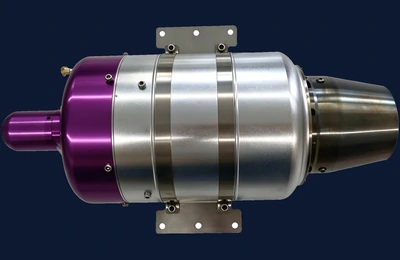
The model says 14 but the thrust says 16 kgf. Which is it?
16 kgf is the measured figure, and it is what the datasheet states at 15 °C ambient. The number 14 is the platform designation carried over from the manufacturer's model code, not a thrust rating. We keep the code so that a customer holding an original factory datasheet can match it to this page; we publish the real thrust so that nobody sizes an airframe against a name.
How much thrust is that in newtons?
16 kgf is 156.9 N, or 35.3 lbf. Expect a small drop on a hot day — thrust scales roughly with air density, so at 35 °C you lose a few percent.
What is the thrust-to-weight ratio?
9.1 : 1 on the bare engine at 1,750 g. That is the bare figure only — add pump, filter, tubing, wiring and the battery branch and the installed ratio falls. We quote bare because that is the number you can verify on a scale.
What battery does it need?
A 3S LiPo at 11.1 V, connected through XT60. The pump runs from a separate XT60 branch off the same pack. There is no 6S or 8S requirement at this thrust class, so the engine shares the receiver battery.
How long can it run on a given tank?
Consumption is 500 ml/min at maximum thrust. A 2 litre tank therefore gives about 4 minutes at full power, and considerably longer at part throttle since flow drops with speed. Plan endurance on the full-thrust number and you will not run dry on approach.
What fuel and oil does it take?
Kerosene with 5 % turbine oil premixed. The 5 % figure is the lubrication budget for the bearings at 120,000 rpm — do not substitute a lower ratio to save on oil.
How often does it need servicing?
Every 25 hours of running. At 500 ml/min that is roughly 750 litres of fuel. Treat the engine as a consumable with a known life rather than a capital item, and the cost per flight becomes predictable.
How is it controlled, and does it log data?
In flight, a standard PWM throttle lead from any receiver channel. On the bench, the Data T/PC ground terminal with an LCD and five keys for start, stop and parameter changes. The terminal has an SD card slot, so each run is written to card — the most useful diagnostic you get when a start does not go the way it did last time.
How does it compare with other 14 to 17 kgf engines?
At 16 kgf the trade-off is weight against idle quality and logging. The SF14 is 1,750 g in a Ø109 mm case, 283 mm long, with a 35,000 rpm idle — the lowest in this band — and an SD-logging terminal that records every run. Lighter and shorter units in this class exist, and they are the right answer when every gram counts. What they generally do not give you is the lower idle or the run log. If weight is your binding constraint, send us the airframe and the model you are comparing and we will return a line-by-line table. If you want the lowest idle at 16 kgf with a logged record of every run, this is the one.
Does it need an export licence?
No, for most destinations. At 156.9 N it is at about 39 % of the 400 N dual-use threshold, so it ships under normal commercial rules. We still ask for a written civil-application statement, and we do not supply it for military or law-enforcement use or for onward export to restricted destinations.