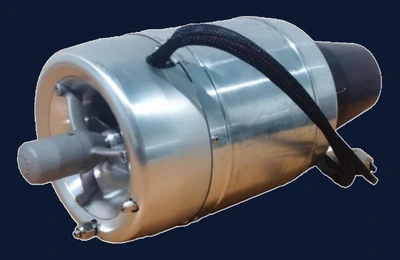
SF60 60 kgf turbojet engine
SF Series · New

SF60

60 kgf / 588.4 N Class · 27,000–83,000 rpm

60 kgf from a Ø175 mm case weighing 5.6 kg — a 10.7 : 1 thrust-to-weight ratio, the highest of any engine we publish. 0.93 kg/s of airflow at 83,000 rpm, and an idle that still holds 2.4 kgf.

60 kgf
Max Thrust
588.4 N
Rated Force
5.6 kg
Dry Weight
10.7:1
T/W (bare)
83,000
Max RPM
Ø175 mm
Max Diameter
Specifications

60 kgf on 5.6 kg of engine

Measured at 15 °C ambient, 1013 mbar. Ten kilos of thrust for every kilo of engine — nothing else in the range comes close on that number.

Thrust & Speed

  • Maximum Thrust60 kgf / 588.4 N @ 15 °C
  • Idle Thrust2.4 kgf
  • Maximum Speed83,000 rpm
  • Idle Speed27,000 rpm
  • Speed Range27,000 – 83,000 rpm
  • Thrust-to-Weight (bare)10.7 : 1
  • Idle Thrust Ratio4.0 % of rated (derived)
  • Exhaust Gas Temperature480 – 850 °C

Dimensions & Mounting

  • Max Case DiameterØ175 mm
  • Overall Length421.9 – 542.6 mm
  • Length, Bare Engine421.9 mm
  • Case Section Length242.6 mm
  • Inlet DiameterØ35 mm
  • Height over Mount Lugs206.3 mm
  • Mount Lug Pattern25 / 12.5 / 5 mm
  • Unit Weight5.6 kg

Airflow & Exhaust

  • Mass Flow0.93 kg/s at max speed
  • Nozzle Outlet, InnerØ107.4 mm
  • Nozzle Outlet, OuterØ140.5 mm
  • Exhaust Gas Temperature480 – 850 °C
  • Specific Airflow15.5 g/s per kgf (derived)
  • Pressure RatioNot published
  • Nozzle TypeFixed convergent
  • Thrust VectoringNone

Fuel System

  • FuelNo. 3 aviation kerosene (Jet A-1 equivalent)
  • Lubricant5 % Mobil Pegasus II or Mobil Jet Oil II, premixed
  • Fuel Flow at Max Speed1,570 ml/min
  • Specific Fuel Consumption1.37 kg/(kgf·h) at max condition
  • Fuel LineNot in this datasheet
  • PumpNot in this datasheet
  • FilterNot in this datasheet
  • Tank VentingNot in this datasheet

Electrical

  • Recommended BatteryLiPo 4S–6S / 6S–7S — see note
  • StarterOn-board electric starter
  • Throttle InputNot in this datasheet
  • TelemetryNot in this datasheet
  • ECUNot in this datasheet
  • Igniter SupplyNot in this datasheet
  • Wiring DiagramNot in this datasheet
  • Battery NoteThe CN and EN pages of the source document disagree — confirm before sizing the pack

Datasheet Scope

  • Published HereThrust, speeds, weight, envelope dimensions, fuel spec, mass flow, EGT, battery class
  • Flight EnvelopeNot published — ask us
  • Operating TemperatureNot published — ask us
  • Start TimeNot published — ask us
  • Acceleration TimeNot published — ask us
  • Time Between OverhaulNot published — ask us
  • Accessories SuppliedNot published — ask us
  • Standard Conditions15 °C, 1013 mbar
Why This One

Ten kilos of thrust per kilo of engine

The SF60 is the lightest 60 kgf engine we build, and the ratio shows it.

10.7 : 1 — highest in the range

60 kgf on 5.6 kg dry. The SF14 reaches 9.1 : 1, the SF120 8.3 : 1. On a 30 kg airframe that gap is worth several kilos of payload.

83,000 rpm ceiling

Higher than any other 60 kgf engine in the range. Small diameter, high blade speed, and a shorter case section — 242.6 mm of it.

0.93 kg/s of airflow

About 15.5 g/s for every kilogram of thrust. Enough margin to run a fixed convergent nozzle without choking at altitude.

2.4 kgf idle — 4 % of rated

A low, stable idle point. You can hold a descent or a taxi without cycling the throttle, and the relight window is wider.

Ø175 mm × 421.9 mm

Bare engine length, before any exhaust extension. Fits where a 200 mm nacelle would not, and leaves 27.5 mm more room than the next option.

850 °C EGT headroom

The published exhaust band runs 480 to 850 °C. Normal cruise sits well inside it, so the turbine sees less thermal cycling than a tight-margin design.

Applications

What a 60 kgf engine flies

All-up weights assume a thrust-to-weight ratio between 0.8 and 1.0 at sea level, static.

High-Speed Target Drone

60 to 75 kg all-up. Fast, small, and cheap enough to be expendable in training use.

Long-Endurance Survey Aircraft

60 to 75 kg all-up. The 1.37 kg/(kgf·h) specific consumption sets your endurance directly.

Heavy-Lift Cargo UAV

60 to 75 kg all-up. 5.6 kg of engine leaves most of the airframe budget for payload and fuel.

Research and Test Bench

A published parameter table and a 4S–7S battery class make it an easy first turbine for a university lab.

Export Status

At 588.4 N the SF60 sits above the 400 N dual-use threshold in 9A012.b.3, at roughly 1.47 times it. An export licence is required for every destination outside China. We do not ship against a bare purchase order: expect a civil end-use statement, an end-user declaration, and destination paperwork before a delivery date is quoted.

If your programme is civilian and your end use is documented, this is a routine filing. If you are not sure which side of the threshold your airframe falls on, ask us before you size the engine — the answer changes the procurement path, not just the paperwork.

Questions

What buyers ask about the SF60

Is it 60 kgf or 588 N?

Both, and they are the same number. The source datasheet is written in kgf; 60 kgf converts to 588.4 N at standard gravity. We publish both so the figure can be checked against either convention.

The battery recommendation is inconsistent — which is right?

The Chinese page of the source document says LiPo 4S–6S, the English page says 6S–7S. We have not resolved this and we are not going to guess. Tell us your bus voltage and we will confirm the correct pack for your build before you order cells.

Is overall length 421.9 mm or 542.6 mm?

421.9 mm is the bare engine, and it is the dimension drawn on the outline drawing. The 542.6 mm figure in the parameter table covers the engine with an exhaust extension fitted. Size your nacelle to 421.9 mm and add the extension separately if you need it.

Is the 10.7 : 1 ratio dry or all-up?

Dry. 5.6 kg is the engine alone, without battery, fuel, plumbing, or starter pack. An installed SF60 in a 60 kg airframe typically lands nearer 3 : 1 once you count everything, which is still ample for a target drone or a survey aircraft.

How does it compare with other 60 kgf engines?

At 60 kgf the SF60 is the lightest engine we publish at 5.6 kg, and the highest thrust-to-weight in the range at 10.7 : 1. What it does not have is a published ECU protocol or a published operating temperature band — we are not going to pretend otherwise. If you need a digital interface at 60 kgf, tell us what your flight controller expects and we will say straight away whether we can meet it. If you need the lightest 60 kgf engine in this class, this is the one.

Is there a serial protocol or an SDK?

Not in the material we hold. This datasheet covers mechanical and thermodynamic parameters only — there is no frame format, no command set, and no telemetry map. If a digital interface is a hard requirement for your integration, say so at enquiry and we will tell you what is actually available rather than let you design around an assumption.

What is the flight envelope?

Not published. The datasheet gives sea-level static performance at 15 °C and 1013 mbar, and nothing about altitude or Mach limits. We do not extrapolate a ceiling from a static thrust figure. Ask us for your specific altitude and speed band and we will come back with a real answer.

What does 480–850 °C exhaust temperature mean in practice?

It is the band the engine runs in, not a limit you tune to. At idle the gas is near the low end; at maximum speed it approaches 850 °C. Keep your nozzle and any downstream structure rated above the top of that band with margin.

Can I buy one unit for a private project?

Above 400 N we need an export licence regardless of quantity, so a single unit is not a simpler transaction than ten. What we need from you is the same either way: civil end use, named end user, destination, and a written statement. If that is in order, one unit is fine.

What are the mounting points?

The outline drawing shows twin mount lugs on the case, 25 mm apart on the outer pattern, 12.5 mm on the inner, 5 mm off the case surface, with 206.3 mm across the lugs. Send us your frame drawing and we will confirm the bolt interface before you machine anything.
Need the full SF60 data pack?

Tell us your airframe, your altitude band, and your destination. We will come back with the parameter sheet, the outline drawing, and a realistic lead time — licence first, hardware second.

Email WhatsApp